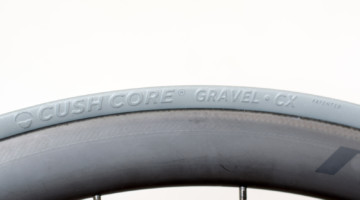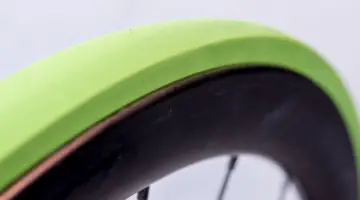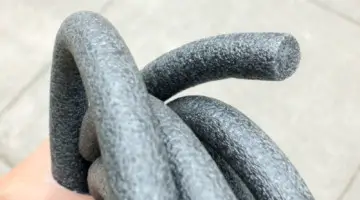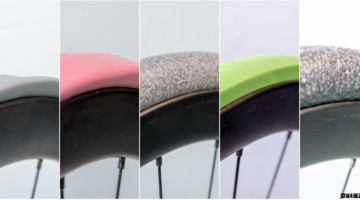









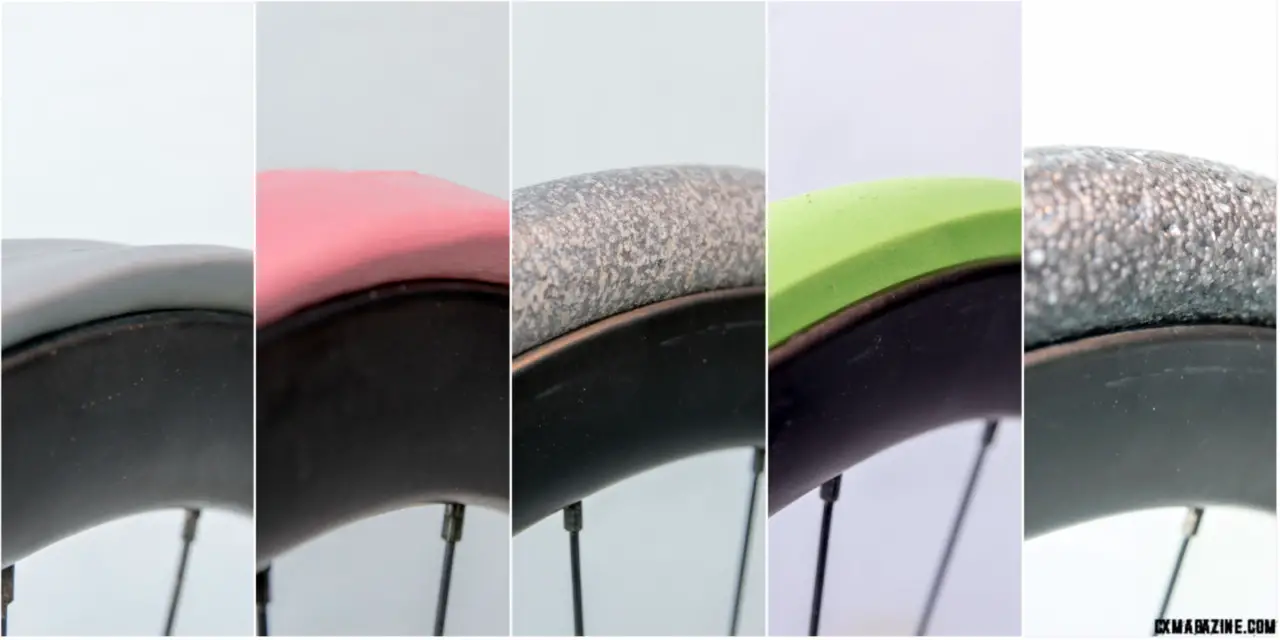
In 2022, we posted a 4-part series on tire inserts. In this series, we cover the use, benefits, and drawbacks of tire inserts for off-road riding. These tire inserts, including the CushCore, Tannus Armour Tubeless, Vittoria Air-Liner Gravel, TurboLight, and a DIY version, are all made of closed-cell foam. Each provides rim protection, but offers different performance characteristics because of their interaction with the tire.
The Odyssey Pneumatic Tire Insert System: OPTIS
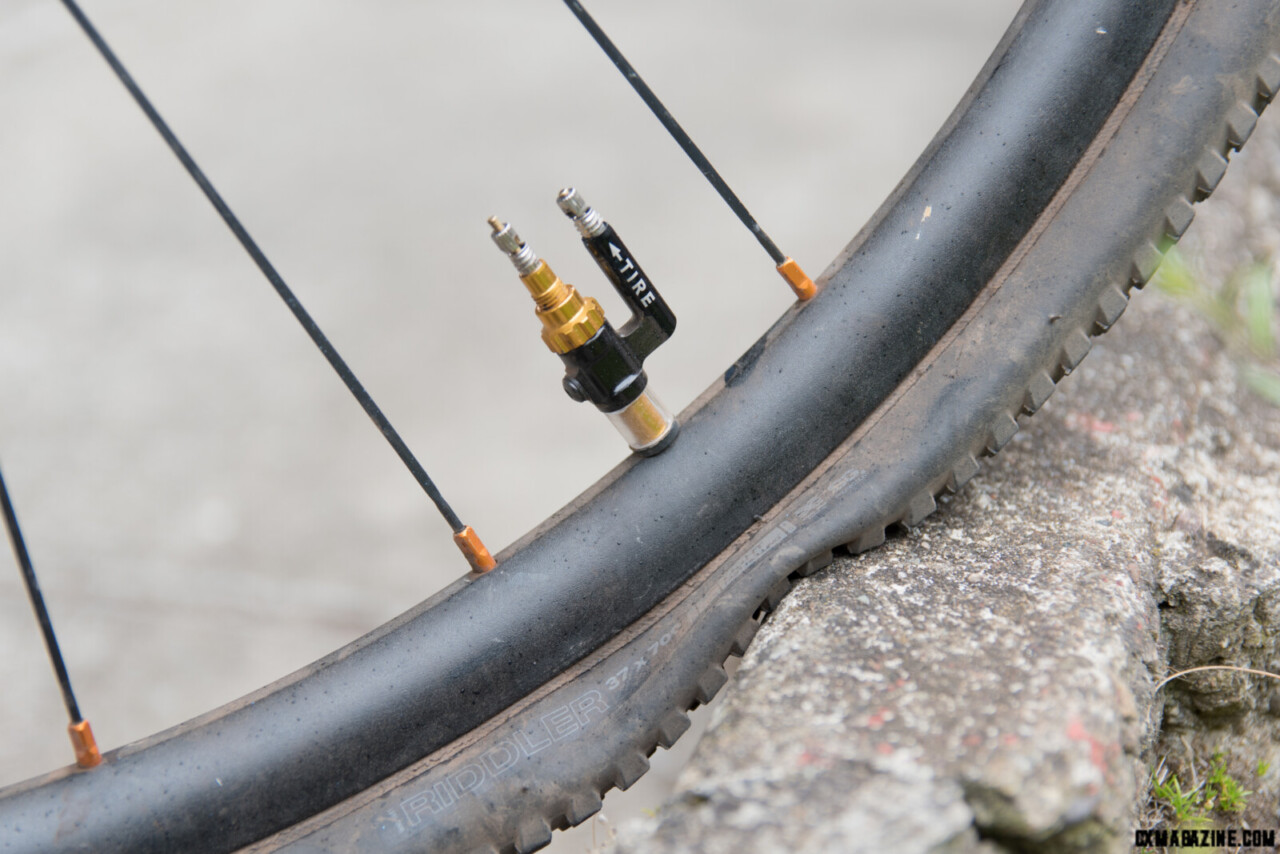
With the tire deflated completely, the OPTIS @ 50 psi provides rim protection and some tire retention.
Odyssey BMX is a strong BMX brand that has expanded into a broader bike market with Fairdale bikes. As riders in the BMX community discovered other branches of cycling, including mountain biking and gravel cycling, they discovered a need for improvement for low-pressure tubeless tires.
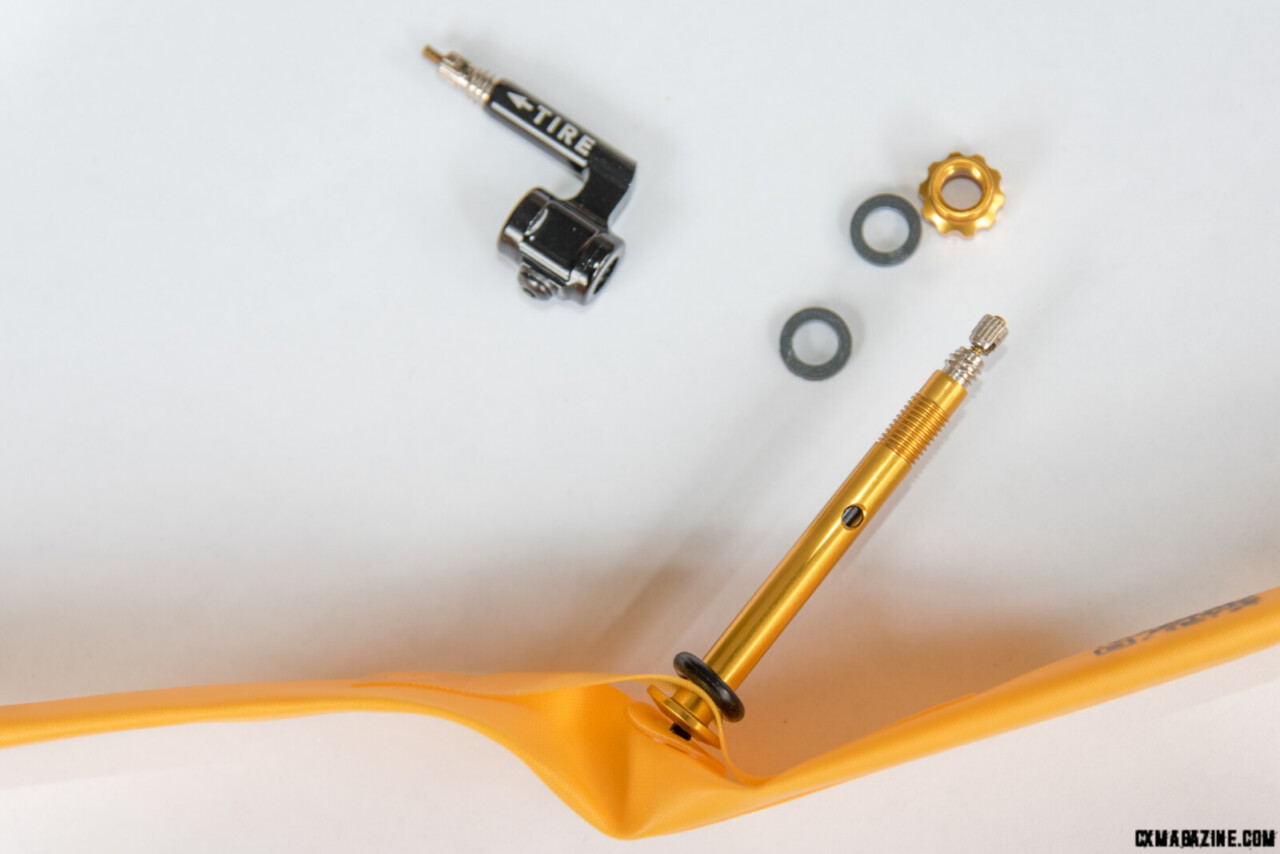
The Odyssey Pneumatic Tire Insert System, OPTIS, is notable for its double valve stems. They are not twins since one piggybacks the other. The OPTIS is an inflatable polyurethane/nylon insert. One of the valve stems fills the insert while the other fills the tire. The valve stems are one inside the other, so only one valve stem hole is needed on the rim. The OPTIS is like a minimally stretchable inner tube.
Introduced a decade ago, the Schwalbe Procore is a double chamber tube system, conceptually similar to the Odyssey OPTIS. Although we have no direct experience with the Schwalbe Procore, it is one level more complicated than the OPTIS with an extra membrane installed around the inner tube portion. During Unbound Gravel 2025, rims with two valve stems were spotted on a couple of bikes. In that case, a pre-installed inner tube was ready to be inflated in the case of a non-pluggable flat.
The OPTIS has elements of both of those ideas, but is technically more similar to the inserts we discussed in our series.
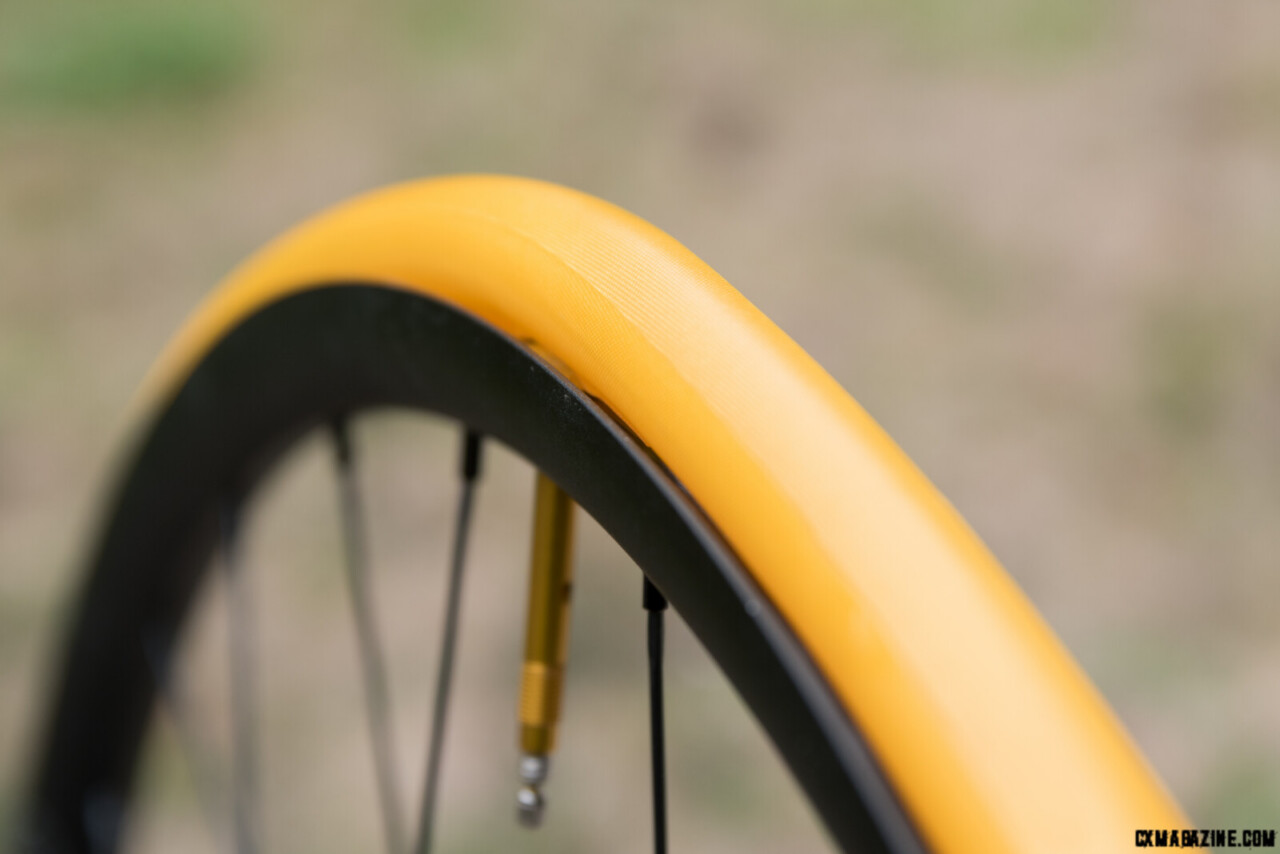
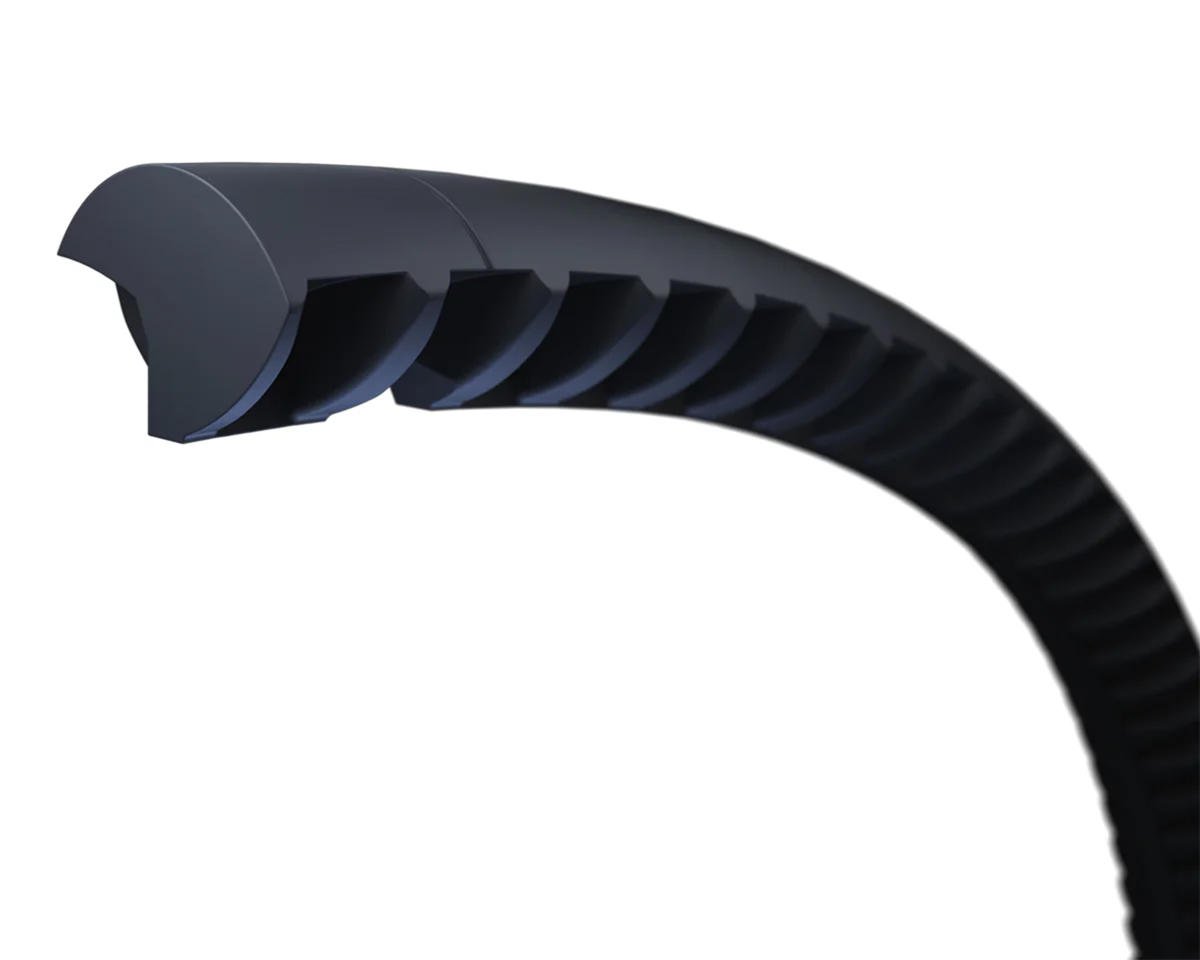
OPTIS inflatable insert.
Are Tire Inserts Still Pertinent for Gravel?
In the four years that have passed since our insert series, tire preferences for gravel have evolved to larger volume, wider, lightweight tires. Recall that the original Cushcore insert stabilizes the low-pressure tire as well as provides pinch-flat and rim protection. Cushcore founder and inventor Adam Krefting did this for mountain bike tires, which are high volume.
Cushcore is not intended to provide tire retention in the case of a flat. Other tire inserts that followed tried to address this, or improve rolling resistance, or lower insert weight. Tire inserts in general give rim protection and prevent pinch flats. Based on the size and shape related to the tire, the tire inserts may affect sidewall stability and therefore tire hysteresis due to contact with the tire sidewall. The latter feature may affect rolling resistance with the tire inflated, but offers better tire retention and rideability with a flat tire.
There are 3 OPTIS sizes: road/gravel, mountain 29″ and mountain 27″. There are 4 valve stem lengths for best fit on a particular rim. This length is important to properly seal the OPTIS to the rim. Odyssey asked for the rim dimensions for the review, so I gave parameters based on what we have available in the CXMagazine inventory. I did not plan to use a tire wider than 50mm for the review.
Odyssey sent me a road/gravel sample with their Type D valve length. This is the second shortest stem length available. The road/gravel OPTIS is 68 grams without the included aluminum valve caps. Odyssey recommends an inner rim width of 23-28mm for this insert.
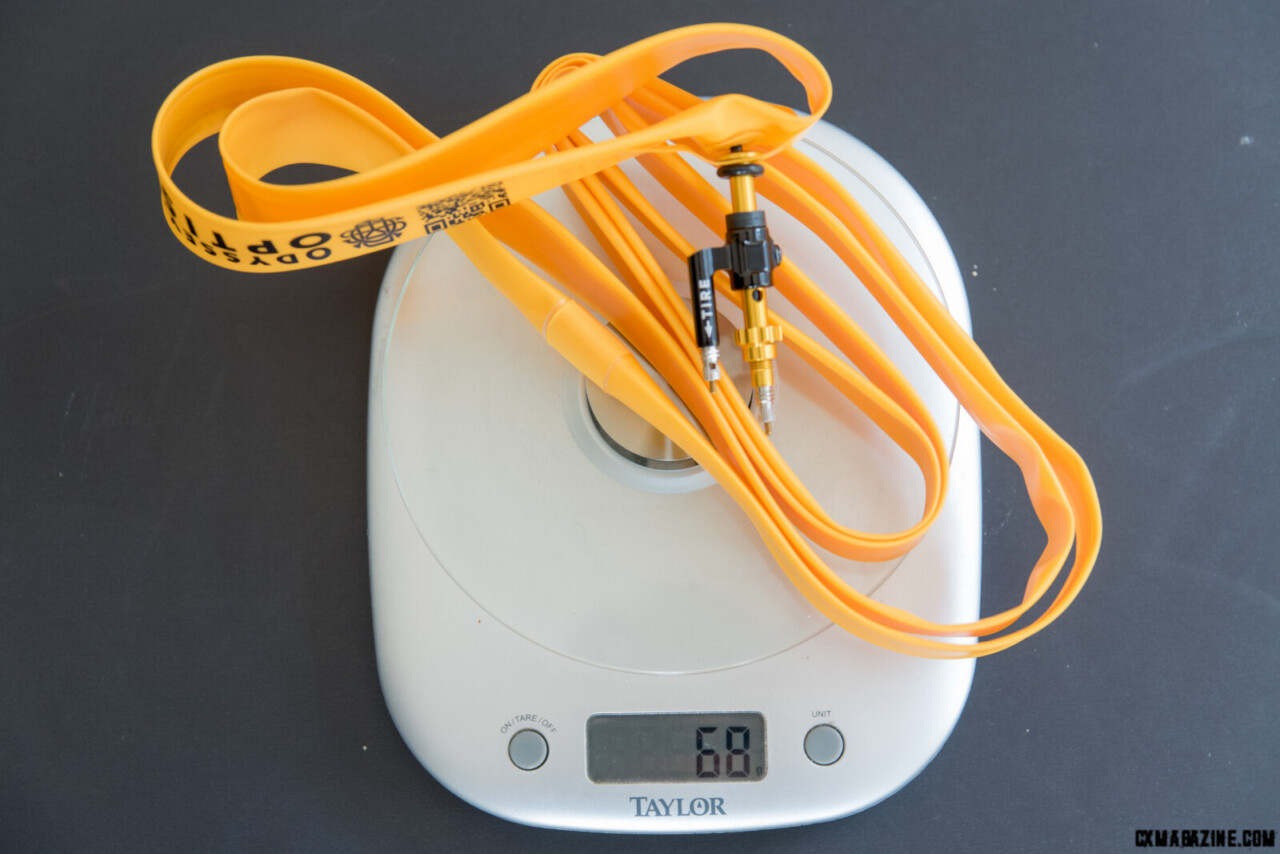
The OPTIS is just under 2.5 ounces
Odyssey warns not to inflate the OPTIS beyond 20 psi until it is assembled to the wheel with the tire. With enough pressure to give the OPTIS some shape, the diameter is 23mm at its widest. It is a bit wider than the old Vittoria Air Liner gravel, and certainly smaller than the DIY backer rod insert. Inside a 45mm gravel tire, the inflated OPTIS will have a cross section approximately 26% of the tire’s internal cross-sectional area. Cross-sectional area is a proxy for volume considering the same approximate circumference of the insert and the tire. For a ‘cross tire, the OPTIS road/gravel insert will fill approximately 50% of the internal tire volume, which is substantial.
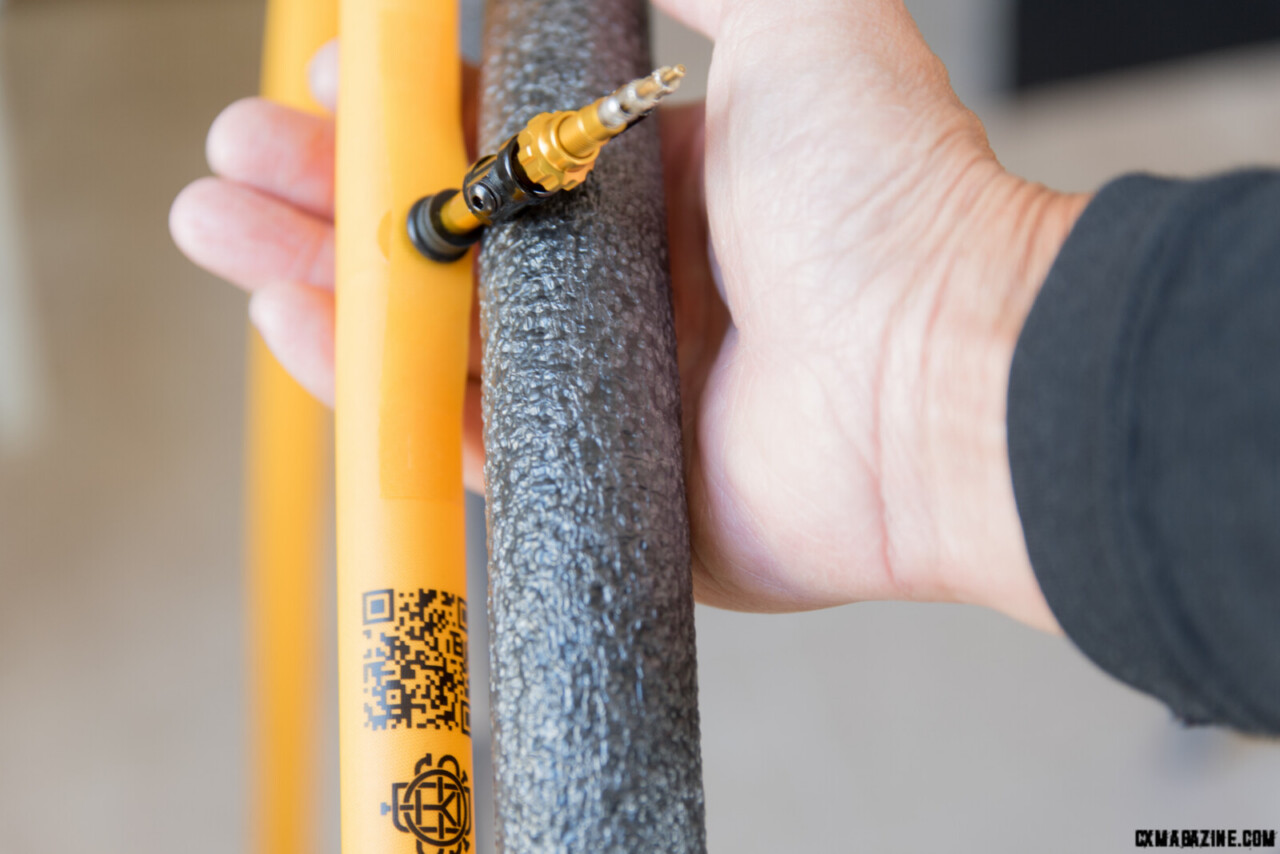
Partially inflated OPTIS compared to a 30mm backer rod DIY insert.
Odyssey OPTIS at Paris-Roubaix
WorldTour road team Lidl-Trek reached out to Odyssey BMX to use the Odyssey OPTIS during the 2026 Paris-Roubaix. Lidl-Trek tested the system through the pre-season and, confident the system offered a real benefit, raced it with success in the 2026 Paris-Roubaix. That certainly lends credibility to the system. Lidl-Trek uses the same insert we use and in a 32mm tire, the OPTIS fills over 50% of the cross-sectional area. A maximally inflated OPTIS will hold the tire on the rim and provide some run-flat capability. If both the OPTIS and tire puncture, some speculate that the high-pressure air will escape the OPTIS into the tire cavity, offering partial tire reinflation as the sealant seals the tire. The Lidl-Trek riders did not experience any punctures.
Odyssey OPTIS Installation
Here is an Odyssey video outlining OPTIS installation. For the initial trial, I used an aluminum rim that is 24mm internal width. The rim is double-walled with a total depth of 26mm. I put a 40mm tire on the rim already prepared with tubeless sealing tape. I did not follow the video instructions entirely. I put the tire on first and installed the lightly inflated OPTIS like an inner tube. I then pulled the second bead on and added sealant before pulling the last section of tire bead on.
Tighten the OPTIS valve stem nut to seal, just like a tubeless valve stem. However, the black second valve stem that fills the tire must align with a hole in the OPTIS stem. Use the included spacers to help with this. This is why matching the stem length to your rim is helpful. You need enough room to fit the second valve, but not so much as to require a tall stack of spacers.
My setup was a bit tall for the rim I chose, but I solved the problem with a spacer I cut from appropriate-size plastic tubing since I did not have enough spacers available on hand. Odyssey will send more spacers if you need them, but they are essentially M6 x 10mm x 1mm plastic washers. With that, everything aligned and sealed up easily with the compression nut. I added sealant before popping the last section of tire onto the rim. Feeding sealant through the black tire valve stem will likely clog the system. I put about 40 psi into the OPTIS at this point. Then I aired up the tire to seat and seal it. I finally aired up the OPTIS to 60 psi. Odyssey recommends OPTIS inflation of 10-25% above the tire pressure, so I inflated well above the recommendation. The OPTIS must be well above the tire pressure so it will not collapse from the tire pressure. The OPTIS, which fits tightly in the rim channel, will help push the bead up onto the rim shelf as the sealant cures.
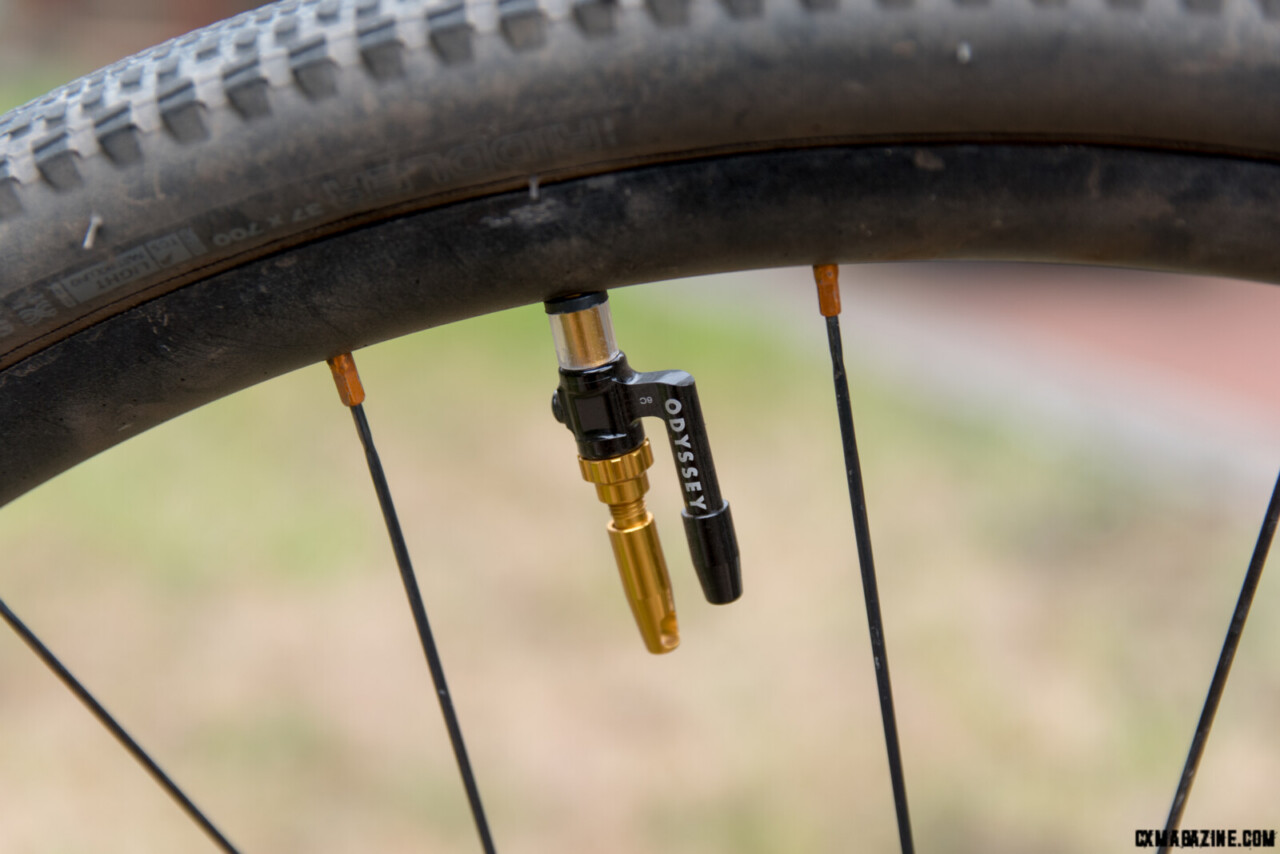
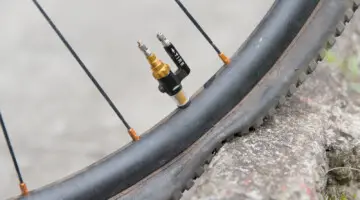
The gold cap has a core remover. Note our DIY valve spacer between the rim and the black tire valve.
In many ways, this installation is easier than with the other inserts. The OPTIS is round, stretchable, and with the inflation low to moderate, it is easy to compress and manipulate within the tire. Once installed, the high-pressure OPTIS will not collapse and will hold the bead on and provide rim protection. Maximum recommended pressure for the OPTIS is 90 psi.
In other ways, installation is more complicated because you have to think about aligning the black piggyback tire valve with the hole on the side of the gold OPTIS valve. Correct spacing of the valves is necessary for alignment and for the compression nut to seal the valve. Add sealant before sealing up the tire; pouring sealant through the black tire valve increases the chance of clogging the valve with its bends and small holes. This means that adding or topping off sealant requires unseating the tire.
A Few Things to be Aware of
The two valve stems are close together, so some large air chucks will not fit. You must remove both valve caps to allow enough room to fill one valve. For field repair of any tubeless system, a pump with a hose is advantageous to avoid breaking the valve seal. This will be more the case with the OPTIS since one valve stem slides over the other.
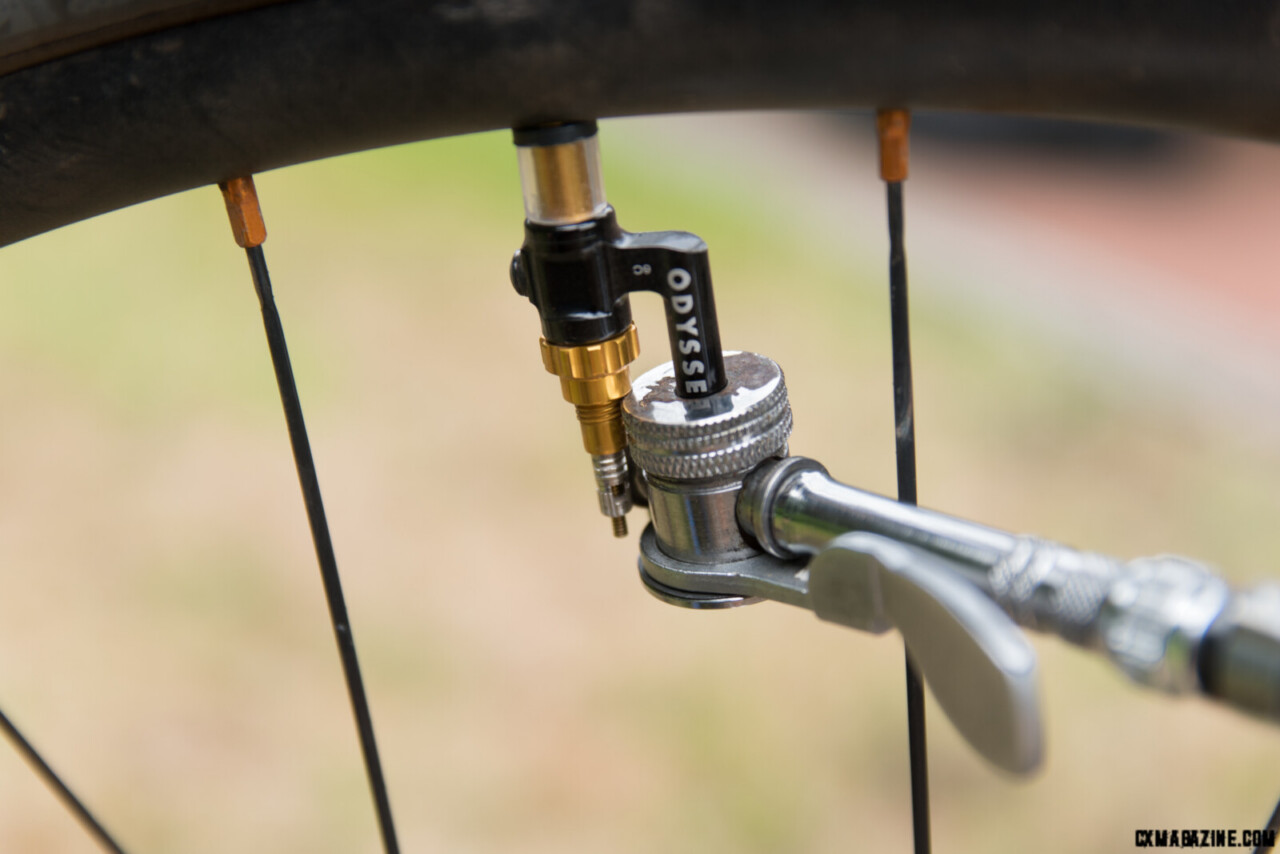
Proximity of the two valve stems creates some interference with a valve chuck. This one does work.
The concentric airways of the OPTIS insert and tire complicate air passage. When the OPTIS inflates to 80 psi, the tire valve does not bleed air out, though air can go in. This means that a tire gauge will not give an accurate reading. If I lower the insert pressure to 60 psi, then the black tire valve operates normally. This was the case with both samples. My workaround is to fill the tire through the black valve first, then bring the OPTIS insert up to pressure above 60 psi. Alternatively, I could just run with the OPTIS pressure at 60 psi. These are higher pressures than Odyssey recommends anyway.
The OPTIS inflatable insert attaches to the valve assembly via a small tube that fits through a slightly smaller hole in the insert. Friction holds this ‘straw’ into the OPTIS with this interference fit. It works, but when doing a “run flat” test, the insert sample in the rear tire moved around enough to let air leak out of the insert at this tube seal and into the tire. Automatic inflation of the tire from an insert reservoir leak is good if the tire is sealed. If the tire continues to lose air, then both the tire and insert will go flat and you lose the ride-flat advantage. I fixed this leak by reseating the valve tube into the insert.
I discussed my experience with Odyssey. Odyssey BMX product engineer Chris Cotsonas reviewed a few run-flat scenarios from their experience:
- A major tire depressurization that seals with sealant: In this case, OPTIS keeps the beads seated and the rider can usually continue riding until they are able to add more air to the tire, or the tire/wheel can be replaced. In one user-case, a road tire lost air and dropped to about 15-20psi, but they were able to ride another ~5 miles until more air could be added to the tire.
- A total tire depressurization where all the air escapes: In this case the bead would stay seated and you would be able to ride on OPTIS for a very short period of time, hopefully enough to realize what has happened and to safely come to a stop. Riding for an extended period of time on OPTIS alone with no air in the tire can cause the insert to separate from the valve (releasing the insert’s air) because when the tire is at zero PSI it will be trying to rotate around the rim, bringing the insert along with it. Having the valve separate prevents the insert from being permanently torn away from the valve, and it allows the rider to reseat and reuse the valve and insert when the tire is repaired or replaced. These situations vary considerably and depend on rider, set-up and terrain. One test rider rode for a long time on OPTIS off-road with the tire at zero PSI, but this is never recommended. The tire should be repaired/replaced ASAP.
- Less common: In the case of losing a lot of air from the tire, OPTIS can in some instances end up releasing air from the insert back into the tire. We know of at least one situation where a rider got a big puncture that damaged the tire and insert, but sealant quickly repaired the tire and the air that was simultaneously escaping from OPTIS then managed to reinflate the tire, allowing the rider to continue on for another 30 miles at near racing speeds.
Re-seating the valve in OPTIS is normal and by design. Future OPTIS offerings will allow the rider to pick between a wider variety of insert sizes and valve lengths, so they can pair them together as needed.
My run flat experience is exactly like scenario #2.
The Ride
I don’t notice the OPTIS when riding, except for the fact that I can go with a lower tire pressure than I usually might for a given tire. The OPTIS reduces the chance that I will pinch or burp my tire, or that I will dent or crack my rim when my tire bottoms out.
Our test included a 37mm WTB Raddler (actually measures 38.5mm), a 40mm Hutchinson Touareg (actual 41 mm) and a 45 mm Vittoria Terrano Mixed Gravel Endurance on a 24mm internal width rim. Vittoria Air Liner is larger than our review sample from a few years ago, so the OPTIS Road/Gravel is now the smallest-sized tubeless tire insert. The OPTIS just fills the rim cavity, but once inflated, it fits tightly into the cavity and offers firm but pliant support for the tire at the bead-rim interface, and adds protection for the rim from impact. The larger the tire, the less relative volume the OPTIS occupies within the tire. The protection will remain similar, but the effect on tire performance and relative ride flat capability declines slightly with a larger tire.
With a narrow tire, such as the road tire used in Paris Roubaix, the OPTIS pushes on the sidewall of the tire near the bead. This stabilizes it and prevents it from flopping with lower pressure. If the tire goes flat and the OPTIS is still at full inflation, the tire folds, but stays on the rim. Though imperfect, it is rideable.
With the OPTIS, I dropped tire inflation pressure until sharp bike handling diminished, then added a couple of psi back. In each case, that is about 3-5 psi lower than I would go without the OPTIS. This indicates that the OPTIS does stabilize the sidewall a bit. The double air chamber that the OPTIS creates is like a volume spacer in a suspension fork. It changes the damping quality of the tire. This is where the OPTIS tunability advantage theoretically plays its role. I lowered the OPTIS pressure in increments to the recommended 25% above tire pressure from my initial 200% above tire pressure. The tire pressure remained a steady 20 psi; the OPTIS pressure changed from 60 to 40 to 25 psi. I am not sure I could notice the difference in tire damping in the various setups I used.
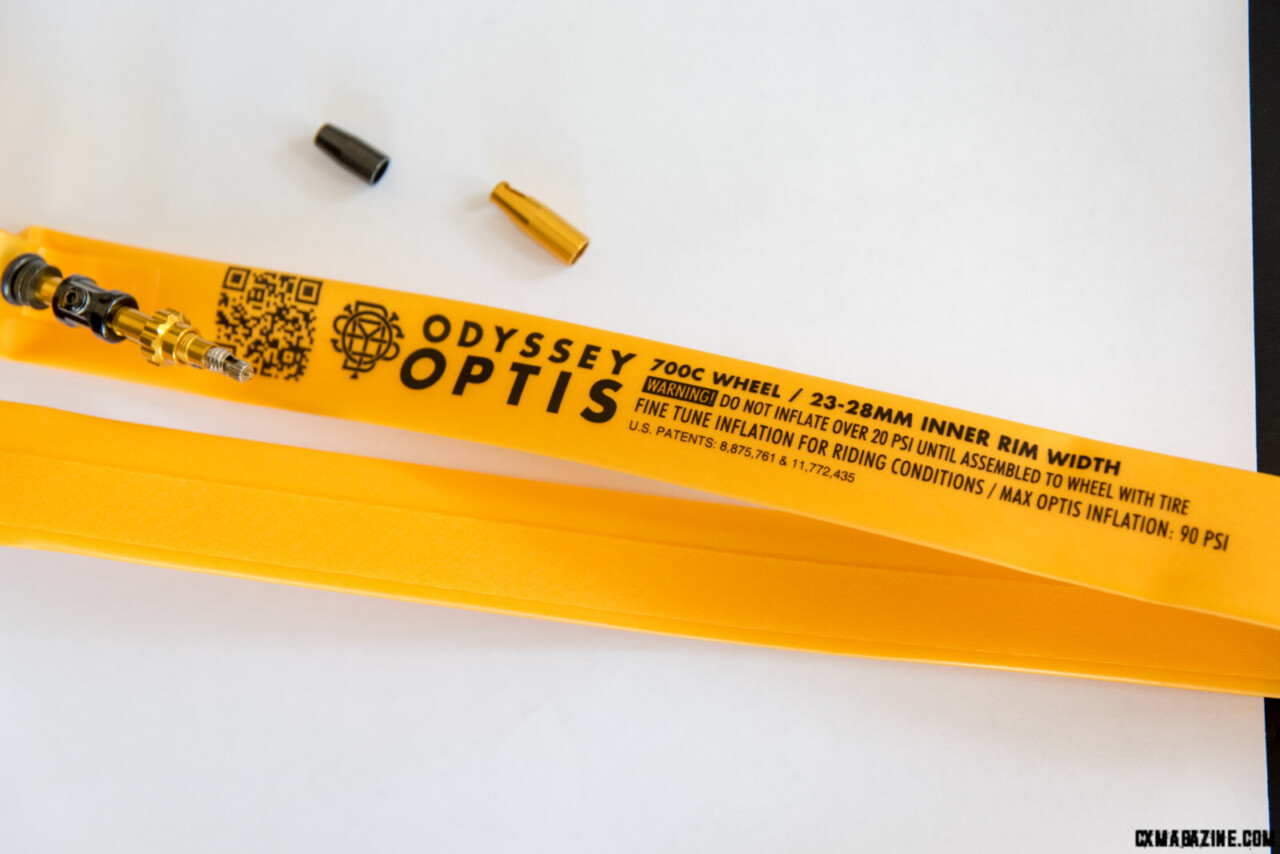
The Road/Gravel OPTIS has a 90 psi maximum rating.
Against recommendations, I rode with each tire completely deflated and felt the OPTIS kept the rim from pinching the tire. Sidewall squirm diminishes bike handling, but the bike is remarkably rideable, especially with the OPTIS at the higher pressures. Again, depending on the air loss scenario, the duration of the ride flat ability will vary. The tire bead never unseated during any of the run-flat tests. The tire and rim combination makes as much of a difference as having the OPTIS insert, in my opinion. The tire retention and run-flat capability is impressive to me.
With the tire deflated completely, the OPTIS @ 50 psi provides rim protection and some tire retention.
Odyssey OPTIS for Cyclocross
I see the Odyssey OPTIS as an ideal insert for cyclocross. The approximate cross-sectional area of the OPTIS compared to the 33mm-38mm tire is 49% to 36%. This is substantial enough to give good sidewall support with a tire running at 15 psi (1 bar). The high pressure of the OPTIS will give enough run-flat performance and bead retention to ride the bike to the pit for a bike or wheel change. In some rare cases, the air in the insert can even refill the tire as noted above.
The Verdict
A tire insert has benefits for tubeless tires on and off road. Lower tire pressure offers traction and a smoother ride with lower rolling resistance. For small or large tires, tire inserts offer rim protection against hard hits when running tire pressure low. Tire inserts may offer some tire sidewall stability to an inflated tire, depending on the tire. Refer to our previous insert series to see how different inserts perform.
The inflatable Odyssey OPTIS eases insertion and removal of the insert into the tire compared to a typical solid insert. However, the initial setup of the valve system adds some complication, and the concentric valve airway has some quirks I described above. Also, topping off sealant, though infrequent, requires unseating the tire.
The OPTIS valve stem air hole corresponds to a hole in the tire valve.
Tuning the insert inflation pressure offers some benefits, but for maximum rim protection and bead retention, a higher pressure for the small insert makes sense. In the event of an unrepairable tire cut that requires a tube, removing the OPTIS and carrying it out is less complicated than with a foam insert. For this reason alone, I would choose the OPTIS over a foam insert.
I think cyclocross is a great application for the OPTIS because it stabilizes the relatively narrow tire when it is at very low pressure and will help the tire stay mounted, as well as offer some ride-flat potential. Lidl-Trek successfully used the OPTIS’ for tire retention and rim protection in the 2026 Paris Roubaix.
Tubeless tire inserts offer great benefits for “underbiking”; that is, using your cyclocross bike on mountain bike trails. I enjoy the challenge of a relatively small, light tire on a moderately technical trail. A tire insert gives the equipment a better chance of survival on those adventures. The Odyssey OPTIS offers rim protection, provides tunability to affect tire stability, gives some ride-flat capability, and is easier to install and remove than a foam insert.
Odyssey OPTIS road gravel USD 90
23-28mm internal rim width, 68 grams
More info:
Odysseybmx.com