











For today's Mechanical Monday, we are taking a look back at the myths of tubeless tires. With all the rumors, both good and bad, about tubeless tires, it is about time to cut through the fluff and give a real accounting of this ever-growing technology. What are some of the common myths that need answering? We've compiled the list below:
Myth One: "Tubeless doesn't work."
Myth Two: "Any cyclocross tubeless tire will work."
Myth Three: "My Road Tubeless or 29er tubeless wheels will work just fine."
Myth Four: "You must use tubeless tires."
Myth Five: "Low PSI means faster."
Myth Six: "Wider rims are always better."
Myth Seven: "You need a compressor."
Myth Eight: "It’s always possible to change a tire the night before a race, or the morning of..."
Myth Nine: "Valves are all the same."
Myth Ten: "Low pressure is the only reason to try tubeless."
Myth Eleven: "Setup is complex and time-consuming."
Myth Twelve: "There are limited options for tires and rims."
Myth Thirteen: "Tubeless is heavier than tubulars, but lighter than clinchers."
Myth Fourteen: "If I can bottom out without burping, I’m good."
Myth Fifteen: "Tubeless is heavier than tubulars"
With top-tier riders like Mical Dyck finishing as the lead North American Elite Rider at the 2015 Cyclocross World Championship in Tabor, tubeless is becoming too relevant to ignore. For quality content like this tech article, be sure to subscribe to our print or digital magazine today, which is also available on Uberflip, in the App Store on iTunes, and on Google Play for Android.
If you find yourself pleasantly surprised by the dispelled myths, and the idea of going tubeless has piqued your interest, be sure to check out our earlier "how to" guide for going tubeless in Issue 25 as well.
Myth Nine: “Valves are all the same.”
Tubeless valves vary greatly. We’ve already emphasized how you can’t just grab any tubeless tire, or any tubeless rim, and expect it to work. The same applies to valves, perhaps even more so. Valves vary greatly in terms of the size and shape of the rubber gasket that sits inside your rim. This piece needs to match your rim’s shape and valve hole perfectly. Buy the valves made for your rim. Trust us on this one… Adding a random valve may have you pumping endlessly, or have your compressor running non-stop, because a poorly-fitting valve will never seal up. Valves also vary in length and some have removable valve cores. Removable cores are great for topping off with more sealant. If you can’t find the OEM valve for your rim, make sure the rubber end matches your originals in size and shape.
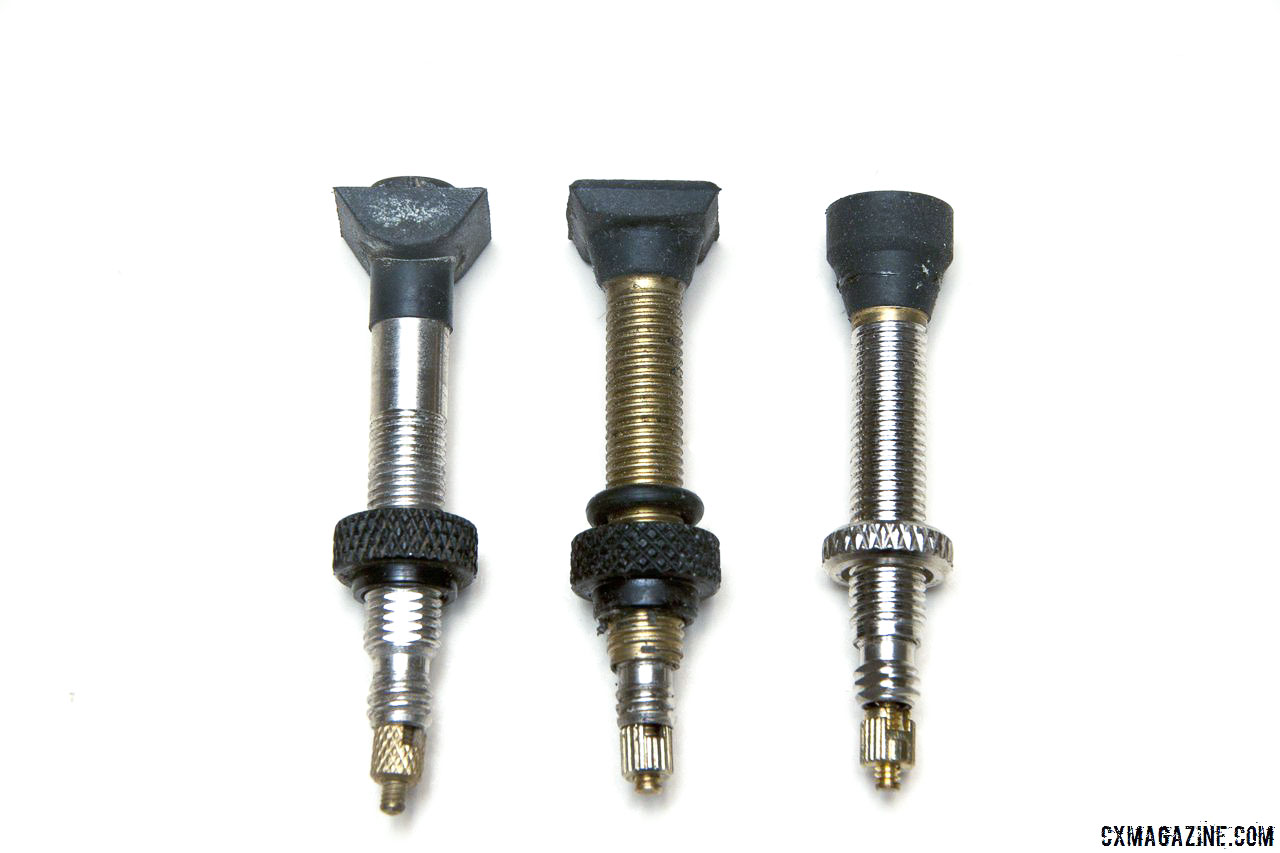
The valve you use is critical: It must fit the rim be, and not all have removable cores. © Cyclocross Magazine