











For today's Mechanical Monday, we are taking a look back at the myths of tubeless tires. With all the rumors, both good and bad, about tubeless tires, it is about time to cut through the fluff and give a real accounting of this ever-growing technology. What are some of the common myths that need answering? We've compiled the list below:
Myth One: "Tubeless doesn't work."
Myth Two: "Any cyclocross tubeless tire will work."
Myth Three: "My Road Tubeless or 29er tubeless wheels will work just fine."
Myth Four: "You must use tubeless tires."
Myth Five: "Low PSI means faster."
Myth Six: "Wider rims are always better."
Myth Seven: "You need a compressor."
Myth Eight: "It’s always possible to change a tire the night before a race, or the morning of..."
Myth Nine: "Valves are all the same."
Myth Ten: "Low pressure is the only reason to try tubeless."
Myth Eleven: "Setup is complex and time-consuming."
Myth Twelve: "There are limited options for tires and rims."
Myth Thirteen: "Tubeless is heavier than tubulars, but lighter than clinchers."
Myth Fourteen: "If I can bottom out without burping, I’m good."
Myth Fifteen: "Tubeless is heavier than tubulars"
With top-tier riders like Mical Dyck finishing as the lead North American Elite Rider at the 2015 Cyclocross World Championship in Tabor, tubeless is becoming too relevant to ignore. For quality content like this tech article, be sure to subscribe to our print or digital magazine today, which is also available on Uberflip, in the App Store on iTunes, and on Google Play for Android.
If you find yourself pleasantly surprised by the dispelled myths, and the idea of going tubeless has piqued your interest, be sure to check out our earlier "how to" guide for going tubeless in Issue 25 as well.
Myth Six: “Wider rims are always better.”
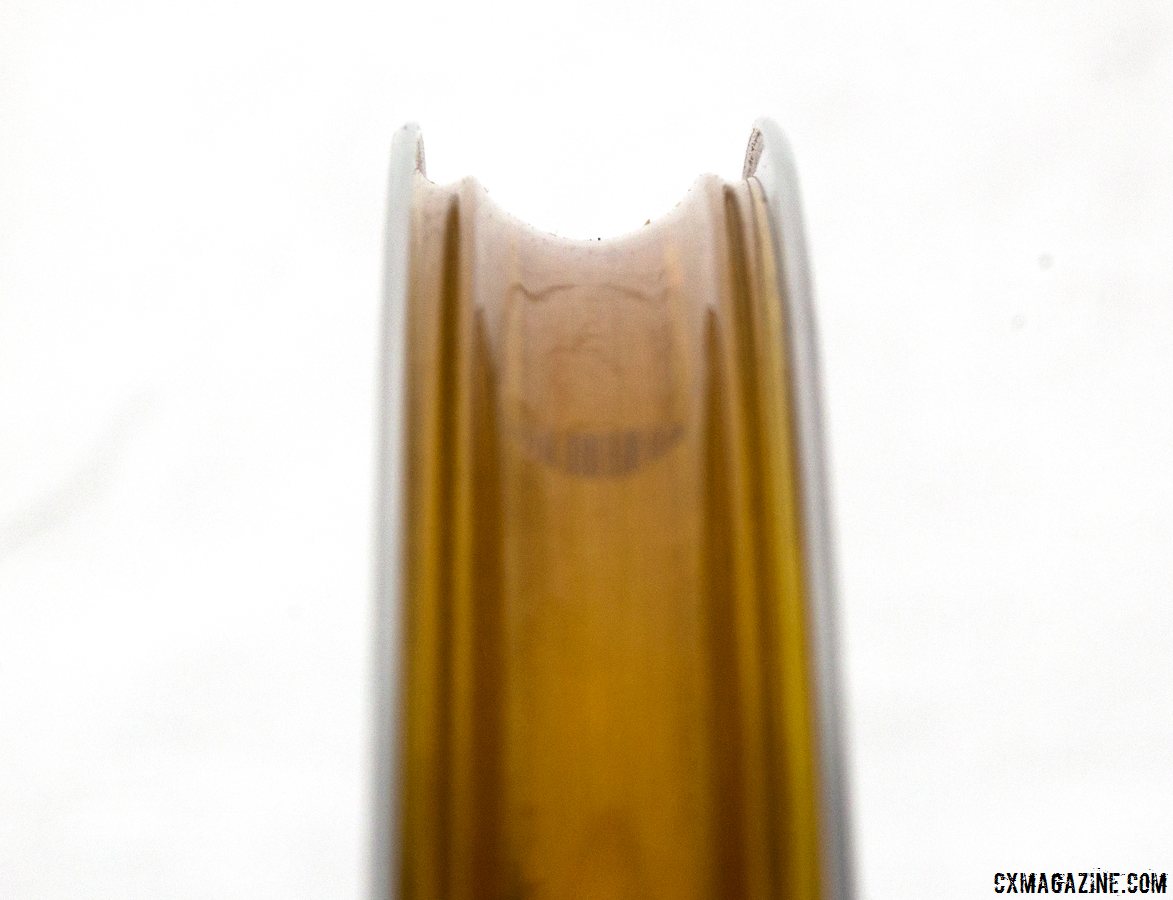
Those giant, wide 29er rims may be appealing for a disc brake cyclocross bike, especially because they’ll add some welcome volume to narrow ’cross tires. And while higher volume may be faster over bumpy terrain, wide rims typically mean a less reliable tubeless setup. Why? A big tire-to-rim-width ratio means that the tire will have plenty of leverage to keep its bead pressed to the sides of the rim. This is a good thing, and it’s also why setting up tubeless MTB tires can be so easy. Put a 2.4″ tire on a 25mm wide rim and it’s going to be hard to burp. As a rim gets nearly as wide as a tire, the tire is more likely to pull away from the rim’s hook bead in hard cornering, increasing the chances it will burp.
Wider is better, however, when we’re talking about the rim’s internal “shoulder” on each side of the center channel. The wider the shoulder, the better the burp resistance. This is one of the reasons NoTubes’ Alpha 340/400 rims were not stellar cyclocross tubeless rims without a rim strip, as the narrow width made for a narrow shoulder, allowing a tire’s bead to drop into the deep center channel in cornering or on impact, causing a burp.
Busting the myths of tubeless tires. © Cyclocross Magazine